Ref; Committed, by Elizabeth Gilbert.
I have just finished reading this book . The author talks about that marriage does not benefit woman as much as it does men, In fact marriage is an institution that has always been very beneficial for men.
"Married men perform ‘dazzlingly’ better in life than single men. Married men live longer than single men, they accumulate more wealth than single men, excel at there careers above single men , are less likely to die of a violent death than single men , they report themselves to be much happier than single men and married men suffer less from alcoholism, drug addiction and depression than single men. There does not seem to be anything statistically speaking that a man doesn’t gain by getting married "
She goes on to say that “dishearteningly the reverse is not true. Modern woman do not fare better in life than their single counterparts. Married woman in America do not live longer than single woman; married woman do not accumulate as much wealth as single woman ( they take a 7% pay cut on average just for getting married) ; married woman do not thrive in their careers to the extent that single woman do; married woman are significantly less healthy than single woman; married woman are more likely to suffer depression than single woman; and married woman are more likely to suffer a violent death than single woman- usually at the hands of their husband, which makes a grim reality that the most dangerous person in the average woman’s life is her own man”
All this adds up to what sociologists called the “Marriage Benefit Imbalance” .
Don’t despair all you married women she goes on to write! "Apparently according to American statistics the imbalance is diminishing and there are some factors that can narrow the inequity considerably . These being – the more educated a married woman is, the more money she earns and the later in life she marries and the fewer children she has and the more help her husband offers with household chores the better her quality of life will be within the married".
Yeah there’s hope! Makes you question why so many of us get married !
This leads to advice all mothers should possibly give to their daughters: finish your schooling , get a good education, delay getting married for as long as possible ( and I would recommend , don’t live with your boyfriends in a pseudo ‘marriage’) , earn your own living , limit the number of children you have and find a man who doesn’t mind cleaning!
As for Nepal ? From what I have observed whilst here , woman work extremely hard married or not married and often forgo further education and careers for marriage due to this being the cultural expected norm as well as limited opportunities . There are significant risks to woman’s health when bearing children and to their unborn children and babies during the birth process. (Statistic’s vary from 3.7 births per woman to over 5 and infant mortality being 59 per 1000 births in 2005) . As far as the incidence of depression in woman in this culture woman I cannot comment besides saying that the statistics on -line quoted high rate’s of mental illness in this country when compared to more developed countries . There is also a high incidence of domestic violence for woman ( physical , sexual ,psychological , and deprivation and neglect ) In one research paper the following figures were quoted , emotional abuse 33% , and verbal abuse 77% and 88% of woman reported daily abuse. The abuse reported was by their husbands . There are less educational opportunities for woman than men with 2/3 of the female population being illiterate as compared to 1/3 of men.
One could therefore conclude that Nepalese woman are significantly more disadvantaged than men , and that marriage further disadvantages them . However on a more positive note , the conversations I have shared with woman did give me a sense that times are changing here for the better , with more awareness , educational opportunities and some Nepalese girls are being encouraged by their mothers to consider their options carefully .
Monday, September 20, 2010

Thursday, September 16, 2010
Monkey Temple
 There are numerous beggars along the ascending steps . We saw a woman holding a baby breast feeding , several small children or small children carrying babies in their arms following you with hands outstretched , asking for food by miming taking food to the mouth. Locals advised us not to give food or money as this only promotes begging.


 Above :The many steps we climbed and the thunderbolt at the top of the steps.
 The Stupa
 Prayer wheels
 Swayambhunath
The Buddhist temple. The temple is known as the ‘monkey temple’ as a large tribe of monkeys that guard the hill that the temple stands on as well as snacking up offerings of food and anything else that you may be carrying. There is a great thunderbolt which you see at the top of the many many stairs you have ascended to reach the temple. Dorje (this is Tibetan word for the thunderbolt symbol in Sanskrit it is called a vajra. This symbolises male wisdom. Dorje are often accompanied by a bell which symbolises the female wisdom.
The eyes of Buddha gaze out across the valley from the top of the stupa (dome). Prayer wheels are set around the base which Monks and pilgrims spin as they pass releasing a sacred mantra. The white painted base represents the four elements- earth, fire air and water. There are 13 concentric rings that symbolise 13 degrees of knowledge and 13 steps that you must take to reach nirvana. (Final escape from the continuous cycle of existence)
Ref : The Lonely Planet
The Many Gods of Nepal
Ref : The Lonely Planet
The three main Hindu Gods are –Brahma, Vishnu and Shiva.
There are a vast pantheon of gods in the Hindu religion which can be looked upon as pictorial representations of the many attributes of a god.
The one omnipresent god usually has three physical representations : Brahma the creator, Vishnu the preserver and Shiva the destroyer and reproducer.
All three gods are usually shown with four arms and have an animal associated with them which is a “vehicle” on which they ride , as well as a consort with certain attributes and abilities.
Each god holds a symbol and you can usually pick out which god is represented by identifying either their vehicle or symbol.
Most temples are dedicated to one or another of the gods but most Hindus profess to be either Vaishnavites ( followers of Vishnu) of Shavites ( followers of Shiva ).
There are also a variety of other ‘lesser gods’
The cow is is the holy animal of Hindu.
Hanuman- The helpful monkey god
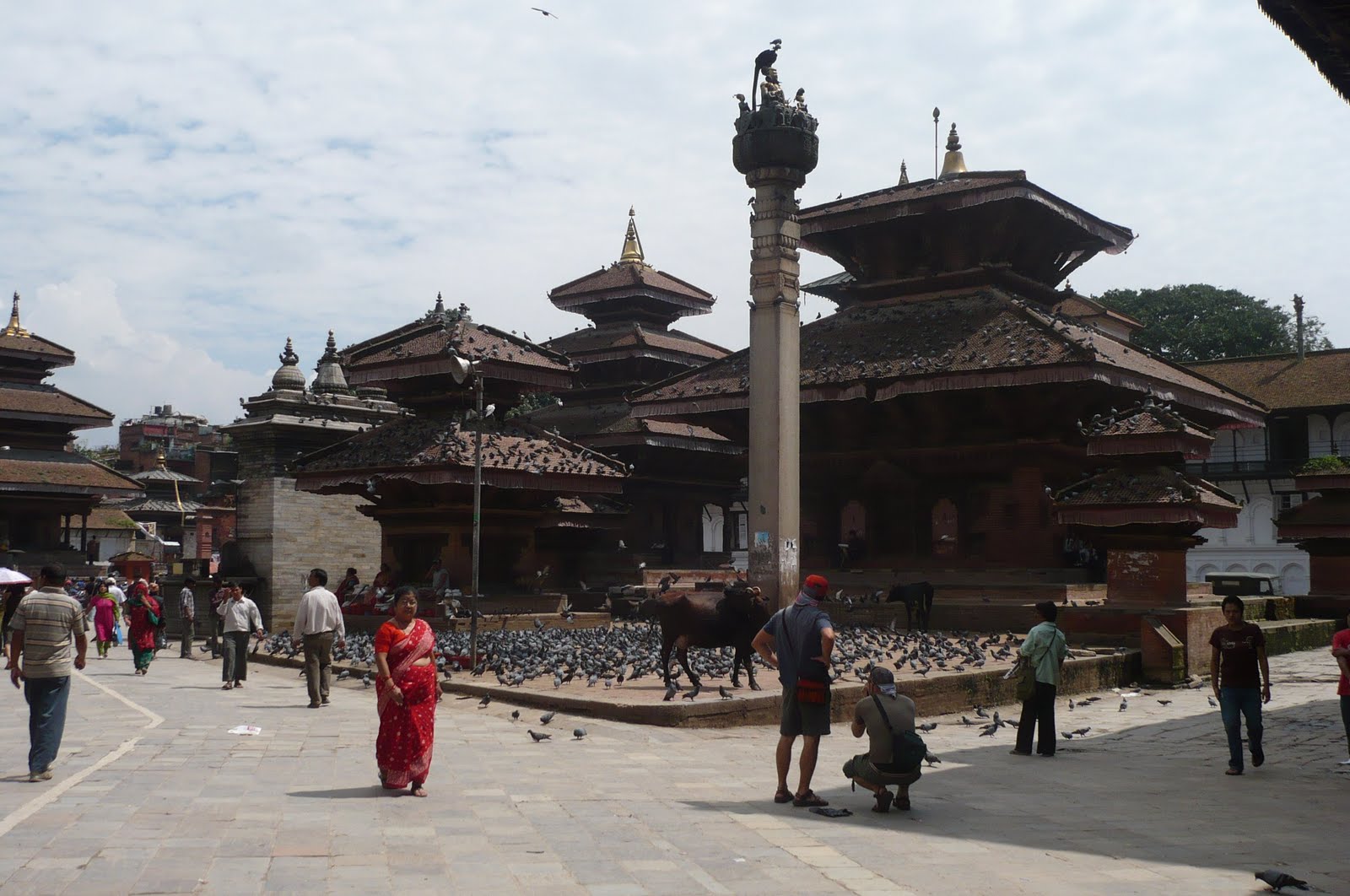
Durbar Square – Kathmandu . This statue stands beside the the old Palace entrance in Kathmandu and gives the old Palace its names –Hanuman Dhoka.
This god has known for its medicinal connection in Nepal and you will sometimes see this on the walls of hospitals . There is a legend about how this god was send to obtain a specific herb for Rama and he returned not just with the herb as he had forgotten what he was asked to obtain so he brought the whole mountain back in hope that some day the mountain would grow the herb

Bhairab God
Bhairab. This is the fearful manifestation of Shiva.( Durbar Square –Kathmandu. Dhorka Palace entrance )
This is Shiva in his most fearful ‘terrific’ form. Bhairab can appear in 64 different ways , none of them pretty. Multiple arms, each clutching a weapon, he dances on a body and wears a headdress of skulls. More skulls dangle from his belt. He is usually black and carries a cup made of a human skull and is attended by a dog.

Temples - Architecture & Cultural considerations
Krishna Temple( Durbar Square Patan ): Krishna Mandir, which is dedicated to Krishna . This temple is ore in Indian design than Nepalese.It is made of stone where as the temples listed below are brick and timber
 Nepalese Temple architecture.-There are 3 styles
 Nepalese Temple architecture.-There are 3 styles
1. 1. Newar Pagoda temples – these are the main feature of the Kathmandu skyline, square in design, either Buddhist of Hindu, Tiered roof 2-5 high. Built on a plinth. Carvings – some erotic in nature

2. 2Stupa’s -Buddhists ( see blog on Monkey Temple also)


3. Shikhara -tapering pyramidal tower which is also surrounded by four smaller towers.

You are to always walk clockwise around the Buddhist Stupa’s, chortens and mani walls. Removing your shoes before entering and we had to remove items made of leather such as belts and bags. Some temples do not allow Westerners to enter at all. It is customary to give a white scarf (khata) when introduced to a Buddhist priest. ( we saw Monks but were not introduced)
Trade Me Ad: Mother for teenage son going free
One sad neglected mother of a teenage son going free to needy appreciative teenage boy .
Description;
Vast experience in quality mothering.
Paid for, project managed and did hands on labouring for large double garage.
Previously cooked wonderful meals, paid car registration and assisted with purchasing trendy clothes to attract the opposite sex.
Advised on styling .
Massaged back, gave loving hugs and looked for monsters under bed prior to going to sleep when scared.( as a small child)
Provides helpful advice and never ending love.
Reason for sale: Used up by previous son who has discarded her in lieu of teenage life, cars and personal interests.
No reserve
Price: Free to caring son who is prepared to make his mother a priority every now and again- weekly would great.
Pick up only ( Nepal) or email; pauline-andrews@xtra.co.nz.
Subscribe to:
Posts (Atom)